A system of concepts for Family Medicine. Multilingual indexing in General Practice/ Family Medicine in the era of Semantic Web
Marc Jamoulle
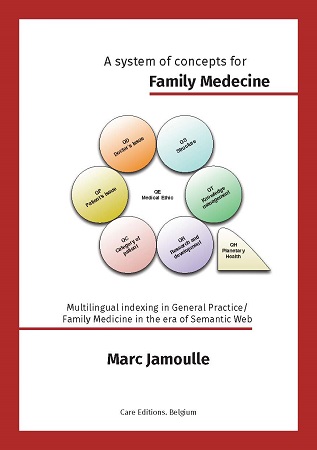
This work presents a new system of knowledge management in General Practice/Family Medicine (GP/FM), supported by a new classification: The Core Content Classification in GP/FM (3CGP). This tool is available in print, but is also fit for use by computers in the realm of the Semantic Web technologies. Giving visibility to the invisible work and accumulated knowledge of family physicians is central to this work. This was made possible thanks to an extensive network of dedicated colleagues in the field of General Practice/Family Medicine, Computer Sciences and Information Sciences.
-
Prix
20,00 €
-
Date d'expédition estimée
Dans 3 jours
-

Marc Jamoulle est médecin de famille à la Maison médicale Espace-Temps à Gilly dans les faubourgs de Charleroi en Belgique depuis plus de 40 ans. Il est affilié au Département de médecine générale, Université de Liège, Belgique. Il est membre du Comité International de Classification de la Wonca, l’organisation mondiale de la Médecine de famille. Patrick Ouvrard est médecin de famille à Angers, France. Il est Vice-Président de la Société de Formation Thérapeutique du Généraliste (SFTG), en charge de la communication et du département Anthropologie Médicale. Paris, France Matthieu Schuers est médecin de famille. Responsable informatique de la Maison de Santé du Pays Neufchâtelois. Membre du Département de médecine générale et du Département d’Informatique et d’Information Médicales. Université de Rouen, France Préfaces par le Professeur Gustavo Gusso, médecin de famille, chef du département de médecine générale, Université de Sao Paulo, Brésil et par le Dr Daniel Widmer, médecin de famille, Chargé de cours, Institut Universitaire de Médecine de Famille, Lausanne, Suisse. Vice-président de l’Union Européenne de Médecine Omnipraticienne UEMO
Voir le profil de Marc Jamoulle -
Towards a system of concepts for Family Medicine. Multilingual indexing in General Practice/ Family Medicine in the era of SemanticWeb by Dr. Marc JAMOULLE Introduction This thesis is about giving visibility to the often overlooked work of family physicians and consequently, is about grey literature in General Practice and Family Medicine (GP/FM). It often seems that conference organizers do not think of GP/FM as a knowledge-producing discipline that deserves active dissemination. A conference is organized, but not much is done with the knowledge shared at these meetings. In turn, the knowledge cannot be reused or reapplied. This these is also about indexing. To find knowledge back, indexing is mandatory. We must prepare tools that will automatically index the thousands of abstracts that family doctors produce each year in various languages. And finally this work is about semantics1. It is an introduction to health terminologies, ontologies, semantic data, and linked open data. All are expressions of the next step: Semantic Web for health care data. Concepts, units of thought expressed by terms, will be our target and must have the ability to be expressed in multiple languages. In turn, three areas of knowledge are at stake in this study: (i) Family Medicine as a pillar of primary health care, (ii) computational linguistics, and (iii) health information systems. Aim • To identify knowledge produced by General practitioners (GPs) by improving annotation of grey literature in Primary Health Care • To propose an experimental indexing system, acting as draft for a standardized table of content of GP/GM • To improve the searchability of repositories for grey literature in GP/GM. Methods The first step aimed to design the taxonomy by identifying relevant concepts in a compiled corpus of GP/FM texts. We have studied the concepts identified in nearly two thousand communications of GPs during conferences. The relevant concepts belong to the fields that are focusing on GP/FM activities (e.g. teaching, ethics, management or environmental hazard issues). The second step was the development of an on-line, multilingual, terminological resource for each category of the resulting taxonomy, named Q-Codes. We have designed this terminology in the form of a lightweight ontology, accessible on-line for readers and ready for use by computers of the semantic web. It is also fit for the Linked Open Data universe. Results We propose 182 Q-Codes in an on-line multilingual database (10 languages) (www.hetop.eu/Q) acting each as a filter for Medline. Q-Codes are also available under the form of Unique Resource Identifiers (URIs) and are exportable in Web Ontology Language (OWL). The International Classification of Primary Care (ICPC) is linked to Q-Codes in order to form the Core Content Classification in General Practice/Family Medicine (3CGP). So far, 3CGP is in use by humans in pedagogy, in bibliographic studies, in indexing congresses, master theses and other forms of grey literature in GP/FM. Use by computers is experimented in automatic classifiers, annotators and natural language processing. Discussion To the best of our knowledge, this is the first attempt to expand the ICPC coding system with an extension for family physician contextual issues, thus covering non-clinical content of practice. It remains to be proven that our proposed terminology will help in dealing with more complex systems, such as MeSH, to support information storage and retrieval activities. However, this exercise is proposed as a first step in the creation of an ontology of GP/FM and as an opening to the complex world of Semantic Web technologies. Conclusion We expect that the creation of this terminological resource for indexing abstracts and for facilitating Medline searches for general practitioners, researchers and students in medicine will reduce loss of knowledge in the domain of GP/FM. In addition, through better indexing of the grey literature (congress abstracts, master’s and doctoral theses), we hope to enhance the accessibility of research results and give visibility to the invisible work of family physicians.
-
Nombre de pages 316 Langue french Type Livre imprimé en niveaux de gris Format A4 Papier Papier standard Couverture Couverture souple Reliure Dos carré collé Lamination Brillant ISBN 978-2-39017-387-8
Vous aimerez aussi